Coming Soon · Join the Waitlist

Funding for Startups

How Fundraising Really Works

by Tom Speechley

Founder, Investor, Fundraiser, Lawyer Raised from 100s of Investors Startup Mentor Managed VC & PE Funds Bloomsbury Professional Author 30+ Yrs Institutional Finance

Most books about fundraising treat it as an art. This one treats it as a science. Capital formation follows patterns. Investors behave predictably once you understand their constraints. The founders who get funded are not more charismatic than the ones who don't; they are more prepared, more deliberate, and clearer about what they are actually being asked to demonstrate.

Written by Tom Speechley, with three decades of experience as an institutional investor, founder and lawyer, Funding for Startups gives founders the framework to navigate a system where most outcomes fail.

Join the Waitlist
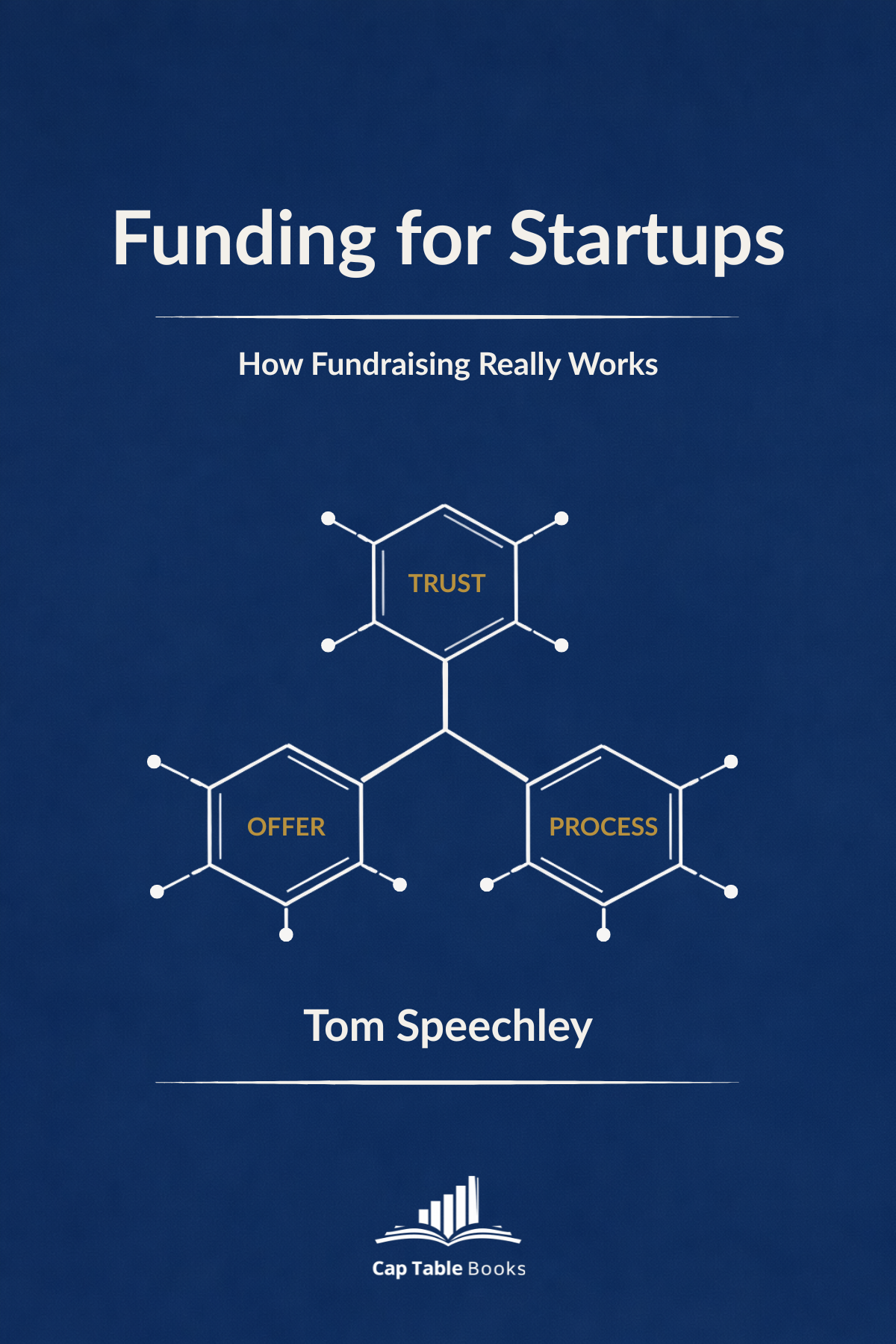

Funding for Startups - How Fundraising Really Works
Who This Book Is For

Written for Founders Seeking Insights From Experience

Founders
Raising capital for the first time and need to understand how investors think, what terms mean, and how to avoid the mistakes that kill most rounds before the first meeting.
CFOs & Finance Leads
Managing the fundraising process from the inside and need a practitioner-level reference on valuation, dilution, due diligence, instruments, and term sheet mechanics.
Early-Stage Investors
Angel investors, family offices, and emerging fund managers looking for a clear, structured view of how venture fundraising works from the founder's side of the table.

What's Covered

Fourteen chapters organised across five parts: from the first decision about whether to raise at all, through to closing a round and managing investor trust over time.

Part I
Should You Be Raising Capital, Now?
Chapter 1
Why Companies Raise Capital
What Kind of Business Are You Building?
Bootstrapping as a Strategy
The Real Constraint: Runway
AI and the New Economics of Early Stage Risk
What Capital Is Actually For
The Right Question
Chapter 2
Are You Ready for Investor Scrutiny?
Proof Before Scale: POC and MVP
The Wedge
Product-Market Fit
Market Size as a Pathway, Not a Slide
Competition as Proof, Not Threat
Unit Economics Are Pivotal
Understanding and Articulating Risk
What Investor Scrutiny Will Actually Test, Summarised
Part II
The Investor Landscape
Chapter 3
Not All Capital Is the Same
Fundraising Requires Specificity
Whose Money Is It?
Constraints Drive Behaviour
Individuals Still Matter
Chapter 4
How Venture Capital Actually Makes Money
Internal Rate of Return (IRR)
Multiple of Invested Capital (MOIC)
What IRR and MOIC Mean For Founders
Loss Ratio
Distributions to Paid In Capital (DPI)
Residual Value to Paid In Capital (RVPI)
Total Value to Paid In Capital (TVPI)
Briefly on Fund Reporting
J-Curves
Risk and Return
The Power Law
Target Return Benchmarks by Strategy
Chapter 5
Funding Stage Map: Who Funds What, When
Capital Sources by Stage of Company Development
A Note on AI and Rising Expectations at Each Stage
Formation Capital
Opportunistic Raise
Pre-Seed
Seed
Series A
Series B
How to Read This Map
AI Is Changing Capital Intensity
Chapter 6
The Different Sources of Capital Explained
Conviction Capital
Founder Capital
Friends & Family
Angel Capital
Angel Syndicates & Funds
Early-Stage Institutional Capital
Accelerators and Studio VCs
Family Offices
Early Stage VC: Pre-Seed and Seed Capital
Institutional Growth Capital
Series A Venture Capital
Series B Venture Capital
Corporate Venture Capital
Series C and Beyond
Opportunistic Capital
Strategic Corporate Investors
Mission-Driven Capital
Grant Funding
Crowdfunding
Customer Capital
A Note on Debt and Quasi-Debt
Ultimately Most Founders Don't Get to Choose
Part III
The Offer
Chapter 7
The Business: What Investors Care About
What an Investor Is Actually Evaluating
Risk, Time, and Upside
What Your Business Must Be Able to Demonstrate
A Defined Customer and a Clear Wedge
Evidence of Demand
Repeatable Customer Behaviour
Customer Acquisition & Retention in the Age of AI
Credible Unit Economics
Durable Advantage (a Moat)
Scalability
Founder Judgement
Optionality and What This Means in Practice
Chapter 8
Valuation and Dilution
Why Valuation Is an Outcome, Not a Starting Point
Objectively Anchoring Valuation
Rule of Thumb, Convertibles, SAFEs and ASAs
Formation Capital Valuations
A Note on Friends, Family, and Distorted Pricing
Pre-Seed Capital Valuations
Seed Capital Valuations
Series A Capital Valuations
Series B Capital Valuations
The Tipping Point: When Valuations Harden
Valuation Is a Price for Risk, Not a Scorecard
Pre-Money, Post-Money, and the Reality of Dilution
Liquidation Preferences and the Limits of Price
Anti-Dilution and the Protection of Entry Price
Option Pools, ESOPs and the Pre-Money Adjustments
Pro-Rata Rights and Future Ownership
Other Structural Protections
The Integrated View of Valuation
Chapter 9
Choosing the Right Capital Instrument
When to Price the Investment: Equity Sets Valuation
Convertible Loan Notes: Deferring the Question
What Triggers Conversion?
SAFEs: Simplicity That Can Hide Complexity
Advanced Subscription Agreements in the UK
Ordinary Equity and Preference Shares
Employee Option Pools
For UK Companies: the EMI Scheme
Debt: A Different Tool Entirely
Venture Debt
Revenue-Based Financing
Bridging Loans: When Time Is the Problem
Jurisdictional Considerations
Choosing Deliberately
Chapter 10
Terms That Matter
Terms That Impact Economics
Liquidation Preferences: Downside Economics
Anti-Dilution: Allocating the Cost of Down Rounds
Additional Downside Protections
Terms That Shape Control
Information Rights: Visibility Without Control
Inspection and Audit Rights: Oversight Beyond Reporting
Board Seats and Observers: Who Sits at the Table
Reserved Matters and Consent Rights: The Power to Block
Influence, Authority and How Governance Evolves
A Note on Voting Trusts
Pre-Emption and Pro-Rata Rights
Transfer Restrictions
Founder Vesting and Leaver Provisions
Employee Equity: Incentives Versus Outcomes
Exit Provisions: How a Sale Actually Happens
Drag Along: Forcing a Sale
Tag Along: Minority Protection
ROFR and ROFO: Controlling Who Enters the Cap Table
Right of First Refusal (ROFR)
Right of First Offer (ROFO)
Exit Assistance
Registration Rights
Why Exit Provisions Matter
Most Favoured Nation (MFN) Clauses
Structure, Terms, and Trust
Part IV
The Process
Chapter 11
Preparing to Raise
Fundraising Usually Fails Before Meetings
Picking the Right Moment to Launch A Raise
Capital Raises Should Link to a Target Outcome
Anticipating The Right Investors For The Stage
Founder Readiness
Preparation Changes the Odds
Chapter 12
Running the Raise
Define the Raise
The Fundraising Strategy
Create the Investor Worksheet
Create a Wish List of Investors
Finalise Pitch Materials
Overbuilding Slides, Underbuilding the Story
AI Exposure Must Be Addressed Expressly
The Pitch Deck's Actual Job
Your Verbal Pitch Matters More
Activate Your Network: Warm Introductions
A Note on Regulatory Hygiene
Networking Events and Intermediaries
Opportunistic Meetings
Raise Through a Tight Window
How Conversations Evolve
Nothing Should Rely on Memory
From Interest to Decisions
Execution Checklist
Chapter 13
Converting Interest Into Capital
Closing Risk Is Real
Due Diligence Is an Opportunity
Managing Diligence Is a Defined Skill
Understand the Internal Decision Process
Standardise Responses
Expect Reference Checks
Curate the Data Room Thoughtfully
Customer References and Data Room Ownership
Honesty, Confidence, and Projections
Legal Documentation and Process
Different Investors, Same Documents, Different Dynamics
The Lead Investor and Competing Term Sheets
Tranched Investments
Legal Execution
Hold The Pen
A Note on Most Favoured Nation Clauses
Differentiated Valuations Within a Round
Avoid False Shortcuts and Bad Capital
Knowing When to Stop
Execution Checklist
Part V
Trust
Chapter 14
Trust: How It Is Built, Tested, and Lost
Trust Bridges Founder and Investor Interests
Soft Trust: Behaviour Under Uncertainty
Hard Trust: Reliability and Follow Through
When Trust Is Tested
What Investors Are Actually Afraid Of
After the Money Arrives
Maintaining Trust: Reporting Best Practice
Establish a Predictable Cadence
The No Surprises Rule
Professionalism in Detail
Communicating Outside the Cycle
The Long View

Join the Waitlist

Funding for Startups is coming soon. Join the waitlist to be notified on publication and receive a preview of the book before it goes on sale.

Cap Table Books

Cap Table Books

Cap Table Books is a new publishing imprint focused on the realities of building, funding, and scaling entrepreneurial companies. Its first book series is The Founder's Library, written for startup founders. Each title is written by practitioners, people who have operated in the roles they write about, with practical, experience-driven content directly applicable to the decisions founders face.

The series starts with a deep dive into startup funding and how fundraising actually works. How the offer, process and trust combine to determine outcomes. Subsequent books cover the tools founders use to build and scale their businesses. There is also a volume to help founders when things go wrong.

There are enough books written about unicorns. The Founder's Library is about everything that comes before those rare outcomes.

The Definitive Library for Founders Building Venture-Scale Companies

Five volumes covering the full journey of building, funding, and scaling an entrepreneurial company. Each book is practical, experience-driven, and written by practitioners who have operated in the roles they write about.

Five Volumes · In Production 2026–2027

Volume 1
Waitlist Open
Funding for Startups
How fundraising really works
In Production
Volume 2
Coming Soon
The Founder's Toolkit
Building and operating tools for modern founders
In Production
Volume 3
Coming Soon
AI-Powered Marketing for Founders
How to get more for less in the age of AI
In Production
Volume 4
Coming Soon
Legal Documents for Startups
How to document your deal and avoid the pitfalls
In Production
Volume 5
Coming Soon
What To Do When Things Go Wrong
Managing through difficult times
Tom Speechley

Tom Speechley

Tom Speechley has spent more than thirty years operating across the full spectrum of corporate finance: as a lawyer, an institutional investor, a founder, and a mentor to early-stage companies. Over that time he has been directly involved in hundreds of financing transactions, from founder rounds to LBOs. That breadth of experience is what makes his view of startup fundraising different from most books on the subject.

He began his career as a corporate finance lawyer, becoming a partner at Norton Rose and Macfarlanes in London and qualifying in New York with Jones Day. He then moved into private equity and later venture capital, running investment platforms and funds across Asia, the Middle East, Africa, and Latin America. Alongside that work, he has founded and co-founded several companies.

Tom is the author of Acquisition Finance (Bloomsbury Professional), a leading professional text now in its second edition and in continuous print since 2008. Bloomsbury Professional have also commissioned Tom to write Financing Entrepreneurial Companies, a companion volume. He writes and speaks on law, finance, and entrepreneurship, and has guest lectured at several leading universities. He has spoken on innovation and healthcare at the World Economic Forum in Davos and the United Nations in New York.